Information about the native app can be found here.
Update: 3/13/26
- Someone emailed me with a question about connecting to my server with the Rdio Scanner mobile app. I added a screenshot to the section at the bottom of the page that might help. For listening on any device other than a computer, the app is the way to go.
- The Live Talkgroup Activity display (on the main page of the site) is project that started out as an idea for a basic visual indicator of traffic across all the systems I monitor. After about a week of working on it a few hours a day, it turned into what you see now. I’m pretty happy with it. I absolutely did not design it with mobile devices in mind as the primary display. It works on phones but I designed it to run in a desktop browser. It is meant for dispatch/communications centers, emergency operations centers, and radio/data nerds (like me). It’s all custom JS/PHP/CSS code. The information is generated from data that already exists in my database. Things like the Talkgroup Traffic Spike indication are dependent on logic that is somewhat rudimentary (because I developed it) and will be refined over time. This, like most of my projects, will never really be “complete.”
- I added a few things to the listener map.
- The issues with the St. Francis County CAP+ system persist and continue to affect FCPD, FCFD, and EMSA. Anything on 155.175 is hit or miss. The other two frequencies that make up this system are fine. This is the Frankenstein’s Monster of radio systems. The difference on the waterfall display on my SDR machine for 155.175 versus 158.7975 is night and day. No amount of signal processing is going to be able to fix it, this is purely an RF issue at this point. I’ll try to do some testing soon to see what, if anything, I need to do to improve the RF situation. Probably something that relates to messing with an antenna/coax, which is one of my least favorite activities.
- I now do some audio processing that helps maintain more consistent audio by raising low levels and lowering high levels across all systems.
- I’m considering a different architecture for the way I’m handling everything on the SDR machine, which would mean new software and a new configuration (and the headaches and growing pains that come with a new way of doing things), but may also mean an overall better system that’s less prone to weirdness and will scale easier.
- I’m not on social media (every platform is a dumpster fire). If you find this website useful, tell someone else about it!
- Drop me a line at admin@eastarknet.com if there’s anything I can do for you.
Update: 2/23/26
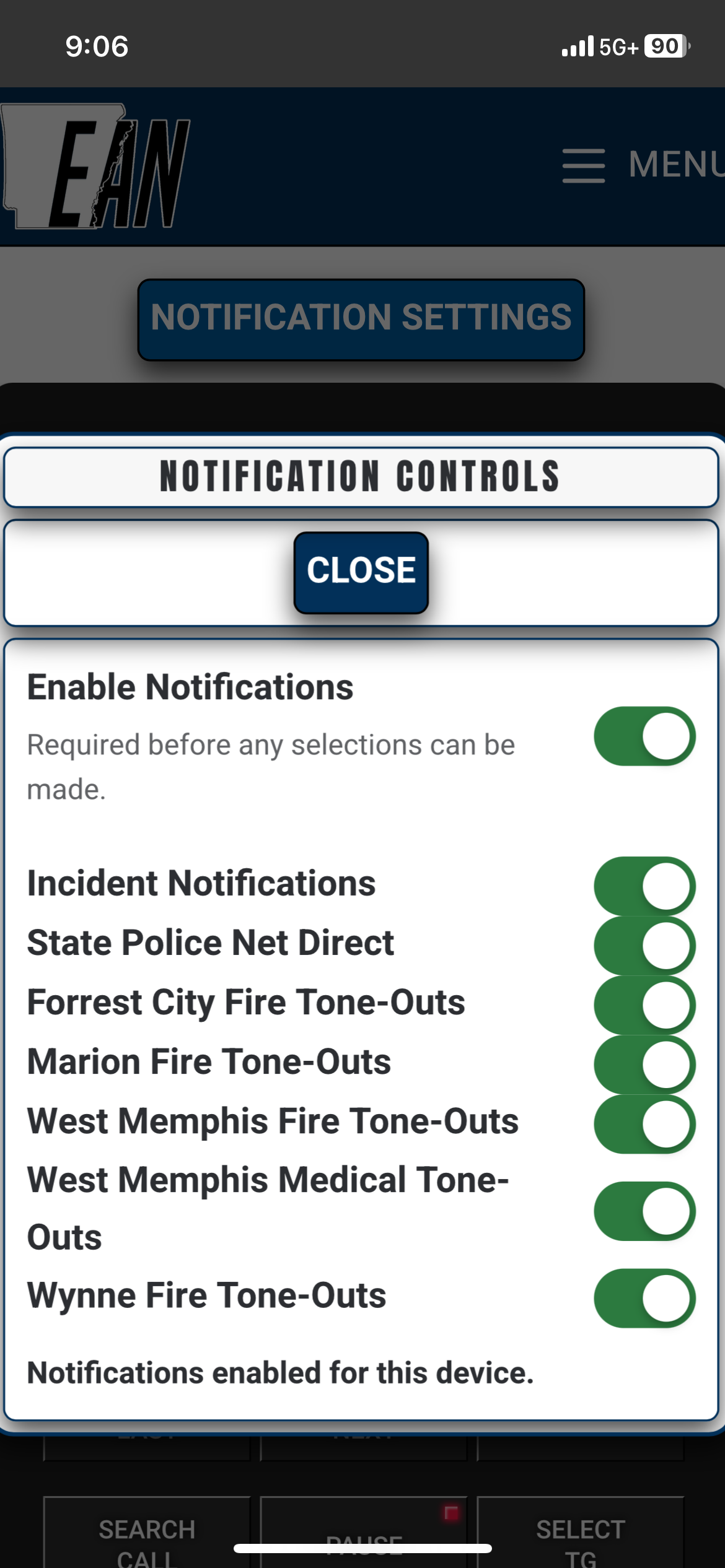
- West Memphis Fire has different tones for medical vs. fire dispatch, so I separated the tone-out notifications accordingly. There are two options for West Memphis Fire Department now.
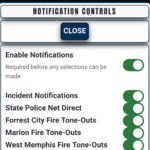 The way to receive these notifications on your phone is by adding EAN to your home screen/installing it from the home page. You should see instructions on how to do it when you visit the site in your browser with your device. Desktop browsers can also receive these notifications.
 - Found a huge bottleneck in the audio routing during the pursuit in Forrest City the other night. There was so much traffic being processed by my server that calls were falling behind. By the time I figured there was a problem and what I needed to do to correct it, the “real-time” feed was off by over 30 minutes. It’s fixed.
- In the process of fixing that, I broke the way traffic from the West Memphis AWIN site was being handled. I didn’t discover that until hours later. It’s been fixed, as well.
- The St. Francis County CAP+ system (used by Forrest City Police & Fire, as well as EMSA) is still giving me headaches on my SDR machine. I worked on it quite a bit over the weekend. This system consists of three different frequencies on three different repeaters in three different locations, resulting in three different signals I have to deal with. While troubleshooting, I discovered at least two of those frequencies are shared by other nearby-ish systems, which my DMR decoder is happily decoding and mixing in with the CAP+ traffic. This is creating an absolute mess, especially since this is a VHF system with a whole bunch of other nearby signals thrown into the equation. One of the repeaters for this system is far enough away from me that the signal gets blasted by closer, more powerful stations. Anytime the rest/voice channel(s) is on that repeater, it struggles and you hear choppy, garbled audio. I’m still trying to find a solution for it that doesn’t cost an arm and a leg.
- All the Crittenden County AWIN traffic is still running on a pair of SDS200 hardware receivers (LOVE these radios). The signal from that site, 35 miles away and on the other side of Crowley’s Ridge, has always been marginal/troublesome. I still plan to eventually move it to the SDR machine, but I’ll probably need a multicoupler (like a Stridsberg MCA204M) to do it. Trying to just ram the signal through a passive splitter with an LNA isn’t going to work on this one.
- ADEM has published the 2026 Storm Plan for AWIN. My system is configured to receive all of the MAC talkgroups, as well as the Law Com, EMS, and Fire talkgroups for Troop A, B, C, and D areas. I can receive traffic for Troops B and D reliably. Troops A and C depend on the current proximity of affiliated radios to sites I receive. Access to some/all of these talkgroups is currently limited to emergency services personnel who have a need for access to expanded, real-time communications monitoring to enhance situational awareness.
- If there’s any way I can somehow help you, contact me at admin@eastarknet.com.
Update: 2/10/26
- If you previously added EAN to your device’s home screen or otherwise installed it, I have made some changes over the past several weeks that you won’t benefit from unless you remove it and add it again. The incident alerts and fire tone-out notifications are working again. There are layout changes that require removing/reinstalling.
- Added some new hardware. I decided to install the 700/800 band pass filter to the Yagi antenna that’s pointed at the West Memphis AWIN site, put a low noise amplifier on the filtered signal, send that to a passive splitter, and then into two SDS200 hardware receivers. The filter did a LOT to knock out local RF garbage and the LNA has more than compensated for the splitter loss. The resulting signal is better than it was when connected directly from the radio to the antenna. One SDS200 is monitoring West Memphis Police and Fire. The other one is monitoring everything else in Crittenden County. This is reducing the number of missed calls from that site by splitting it between two radios. I’ll eventually move that antenna to the SDR system so there are NO missed calls. As usual, it’s money that’s holding things up. I have to buy hardware. That’s basically what this hobby is…buying hardware. For this upgrade, about $200.
- I moved the St. Francis County Capacity Plus system from one of the SDS200 hardware receivers to my SDR system. The “chopped up” audio is because of how CAP+ systems do their trunking. Instead of having a fixed control channel that “directs traffic” on the system (like P25 systems such as AWIN do), CAP+ systems have a “rest” channel that rotates. This particular system has three frequencies, each split into two slots, resulting in six possible channels, all of which can either be a voice channel or the rest channel. In theory, my SDR software should be able to figure this out and assign one of the three available tuners to go sit on the new rest channel when a voice channel is assigned, while simultaneously monitoring the voice channel. This process should be happening seamlessly, every time a voice channel is assigned. Instead, for some reason, my SDR software is “chasing” concurrent voice channels or retuning one of the tuners to check a rest channel that’s out of a receiver’s current bandwidth. The result is broken, choppy transmissions that happen sometimes to any of the agencies on that system (Forrest City PD, Forrest City Fire, St. Francis County, and EMSA). If I can’t make it work, I’ll have to move it back to one of the hardware receiver units and settle for one channel at a time that’s not sometimes chopped into one-second pieces. I am not a fan of this radio system. St. Francis County Sheriff’s deputies and most of the small law enforcement agencies in the county use an AWIN talkgroup. I hope everyone else follows suit and they get away from the CAP+ system but, seeing as how the license for this system is good until August of 2034, they’re probably stuck with it for a while.
Update: 2/5/26
To Do:
I have all of this hardware on hand, I just have to find time to actually do the work.
Install new triplexer on my discone antenna (to separate out UHF/VHF).Install new 140-160 band pass filter on the VHF output of the triplexer (to eliminate intermod on the VHF DMR systems).Install new 700/800 band pass filter on the UHF output of the triplexer (to eliminate intermod on AWIN sites).This antenna still needs a filter. I ended up using this filter on the Yagi antenna.Install new low noise amplifier in the 700/800 signal chain (to compensate for 8-way passive splitter loss to receivers for AWIN sites).Install, connect, configure two new SDR receivers (brings total count to nine).
There’s hardware I need that I don’t have, which costs money (that I also I don’t have):
Band pass filter for the Yagi antenna pointed at the West Memphis AWIN site (intermod is causing serious issues here).Still have to buy one ($130) because I used the one I bought for the discone on this antenna instead.Low noise amplifier for the West Memphis AWIN site (to help with the barely-usable signal and a passive splitter).
I also have work to do on the website/app:
Design a new incident alert/fire tone-out interface so you can start getting notifications on your phone again.- Create a help/how-to for using the “scanner” to listen to live radio traffic, and how to use it to search for and listen to recorded radio traffic.
I have a few other ideas I’d like to implement eventually and a few other tasks to tackle that aren’t on this list. More on those later.
If you’re a public safety official and have a need for any of the audio/data I don’t make available to the general public, or if there’s another need I can help you with, email admin@eastarknet.com and I’ll do what I can.
Update: 1/29/26
Just a quick note: I’ve been very sick for a couple of weeks and, as a result, I haven’t been able to do much. I discovered that one of my amplifiers burned up Saturday, which is why there was a couple of hours of silence from many of the AWIN talkgroups late Saturday morning. I replaced that amplifier with one I had purchased for the West Memphis AWIN site, so that set things back some. Not being able to work doesn’t leave much money for amplifiers, so a new one will have to wait. I hope to have my feet back under me soon.
Update: 1/14/26
SORRY ABOUT THE MESS!
If this isn’t your first visit and things look weird, try deleting/re-adding EAN to your home screen, clearing your cache, temporary files, etc.
In the coming days (or weeks), I will put together a “how-to” to help people understand all the features of the new system. You may have noticed a significant increase in the number of talkgroups/frequencies/channels I monitor (current list here). I’ve made substantial hardware upgrades and have more hardware on the way. I will also need to make an antenna configuration change soon to help deal with the West Memphis AWIN site.
I “switched on” this new system at 5:30 AM on January 1, 2026. As of 9:50 AM on February 5, 2026, the system has recorded 295,098 individual radio calls, all of which are indexed and searchable and can be replayed on demand.
This includes talkgroups which are not available to the general public, but which are monitored by this system. I would be willing to make these available to public safety personnel (the percentage of those personnel who indicate they would find it useful is significant) but I’d have to be able to verify they actually are public safety personnel. It’s on the to-do list.
ABOUT THE NATIVE APP
There’s an app for Android and an app for iOS (that I did not create, do not maintain, and do not profit from) which will allow you to connect directly to my server. The app can do some stuff the web-based client can’t. It plays nicely with your media players and controllers. The app has ads. You don’t like ads, I don’t like ads. Nevertheless, they are there. They don’t have any effect on how the app does its job, they just exist. You can pay to remove them or not, or you can use the web-based client.
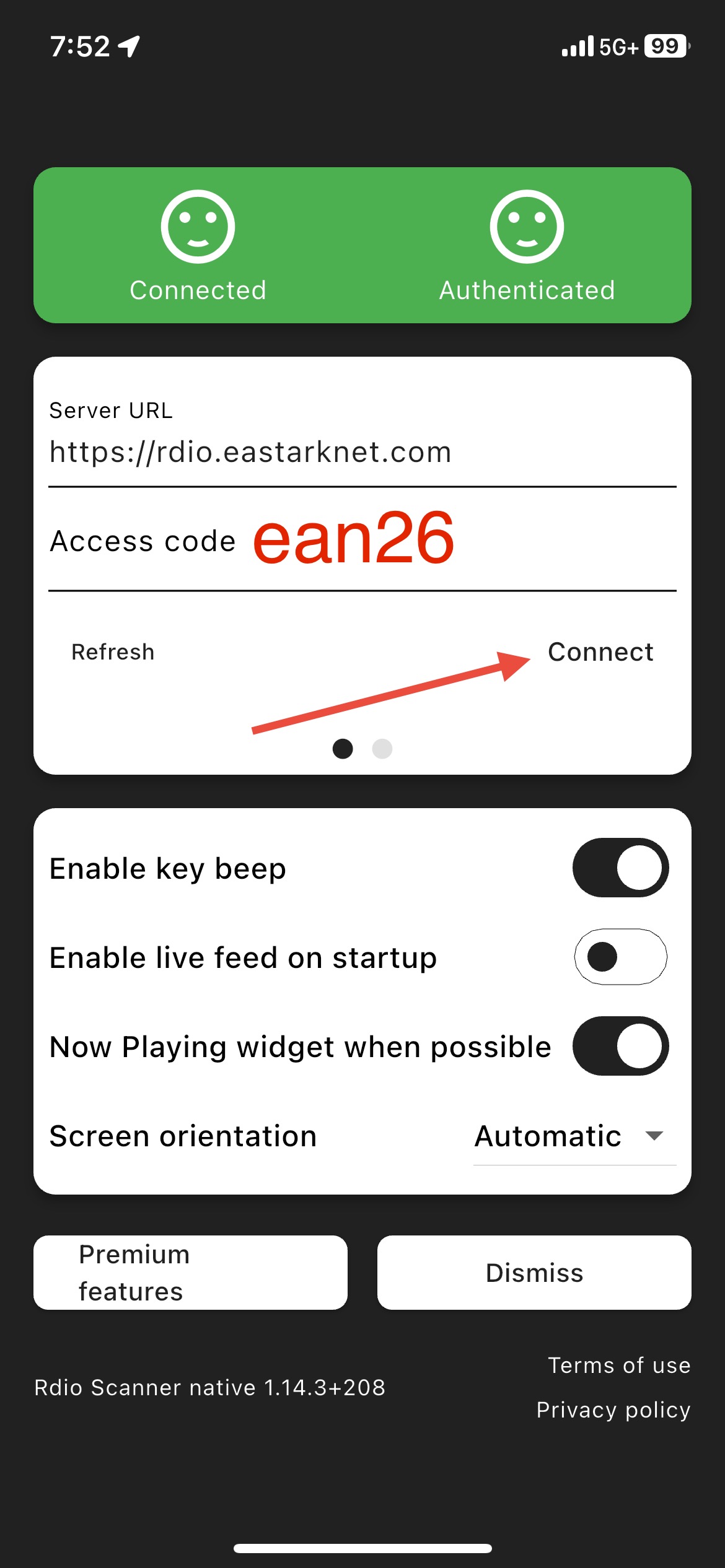
If you use the native app, the Server URL is:
https://rdio.eastarknet.com
Note the absence of an “a” in “rdio.” That’s intentional.
The Access Code is still “ean26” for guests.